A new research lead from The Hague connects a Hirschland family home, three wartime deaths, two surviving sons, and a present-day effort to return their names to the street.
A neighbor begins asking questions
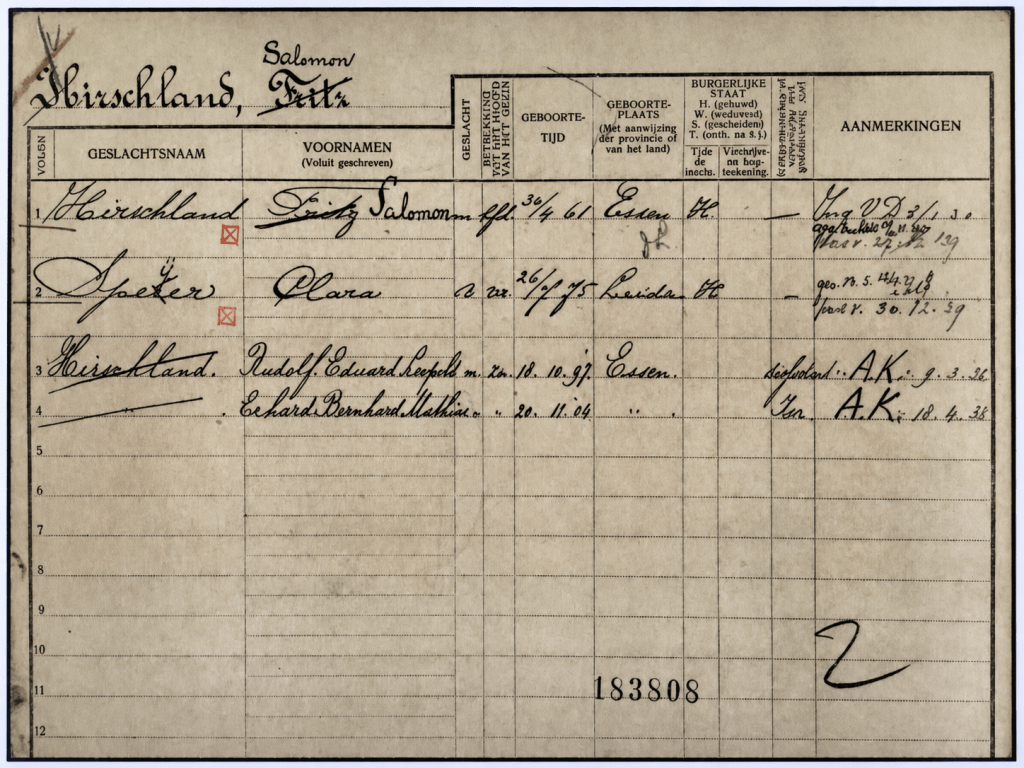
In July 2026, Hans de Herder of The Hague wrote to Victoria Hirschland Hess after finding the Hirschland family through genealogical research. His interest began very close to home: the garden behind his apartment borders the site of the house where Salomon “Fritz” Hirschland, his wife Clara, and members of their family lived before the German occupation of the Netherlands.
Hans is reconstructing the family’s timeline and seeking permission to place Stolpersteine—small brass memorial stones laid in the pavement at a victim’s last freely chosen address. His work turns a street address into something more: one lost home, one family, and an effort by a present-day neighbor to return their names to the place from which they were driven.
From Essen to The Hague
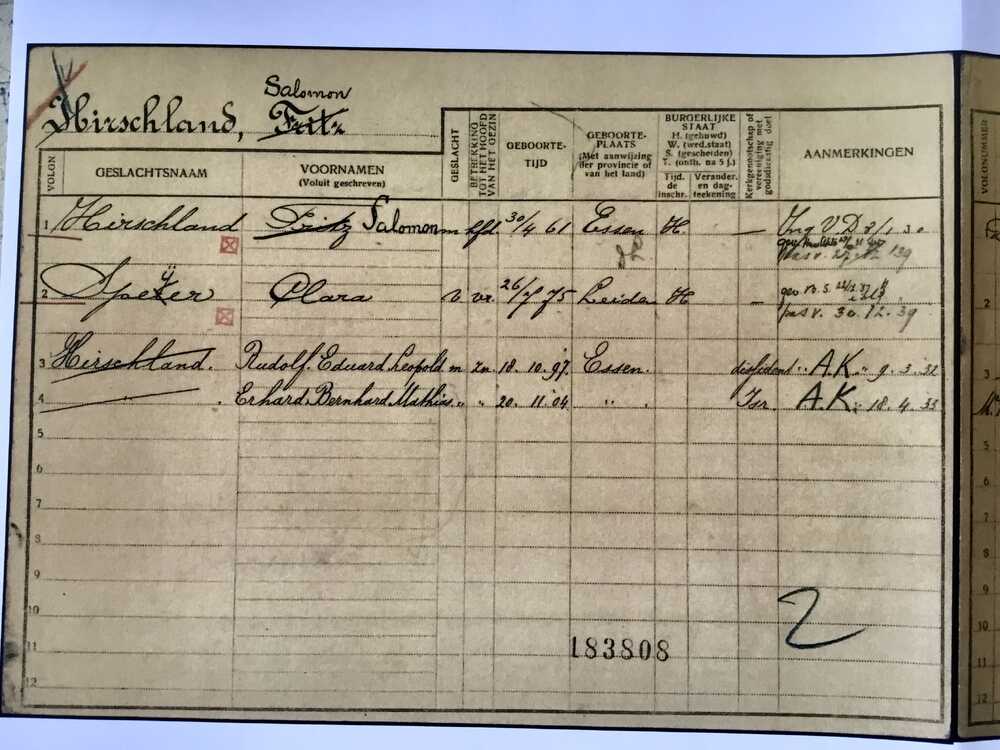
Salomon “Fritz” Hirschland was born in Essen on April 30, 1861. A physician specializing in diseases of the ear, nose, and throat, he also took an active part in Essen’s musical, theatrical, and artistic life. Family and historical accounts remember him as an art lover and accomplished pianist whose home welcomed musicians and artists.
He married Clara Speijer, born in Leiden on July 26, 1875. They had five sons: Arthur, Rudolf, Wilhelm, Erhard, and Herbert. Arthur and Wilhelm died as young men, before the Nazi period. Rudolf and Herbert survived the Second World War. Erhard did not.
Salomon and Clara moved from Essen to The Hague in 1929. The Digital Jewish Monument records the family at Jacob de Graefflaan 9 in May 1940, the month Germany invaded the Netherlands.
The house and the Atlantic Wall
According to Hans’s reconstruction, the family’s villa stood within the zone later cleared for the Atlantic Wall, the German coastal defense system. Residents were ordered to leave, and large sections of The Hague were demolished. The original Hirschland house no longer survives.
Map: Open Jacob de Graefflaan 9 in Google Maps, or see the address map and documented residents at the Digital Jewish Monument.
Image note: We have not yet located a verified historical photograph of the demolished villa. Hans is assembling documents and images, and this article will be updated when a properly identified house photograph becomes available.
Hiding, betrayal, and deportation
After leaving their home, Salomon and Clara eventually stayed with their son Herbert and his wife Gertrude in Utrecht. Hans’s research indicates that they then hid at two addresses. At the second address they were betrayed and arrested.
Salomon and Clara were imprisoned in Camp Vught in April 1943 and transferred to Westerbork. Salomon died in Westerbork on May 14, 1943, at the age of 82, and was cremated there. Clara was later deported to Bergen-Belsen, where she died on August 16, 1944.
Their son Erhard Bernhard Mathias Hirschland, a lawyer born in Essen on November 20, 1901, had already been imprisoned and deported. He was murdered at Auschwitz on January 7, 1942.
Words matter in telling this history. The records use different forms of evidence and establish different immediate circumstances, so this account names each place and event as precisely as possible. It does not soften the larger truth: Salomon, Clara, and Erhard were victims of Nazi persecution, imprisonment, deportation, and murder.
The surviving sons
Rudolf Eduard Leopold Hirschland, born in 1897, had moved to The Hague and worked as a banker. He survived the war and died in The Hague in 1972. Herbert Hirschland, born in 1906, also survived; he died in 1984.
Returning the names to the street
Hans is now asking the municipality of The Hague to recognize Jacob de Graefflaan as the family’s last voluntary address. An initial request was rejected because later records placed family members in Utrecht. His research argues that those Utrecht addresses followed forced evacuation and therefore should not displace the family home in The Hague as the proper memorial site.
The proposed Stolpersteine would make the history visible at street level. Passersby would encounter the names of Salomon, Clara, and Erhard not only in an archive or database, but at the place where the family had lived before persecution drove them away.
Sources and further reading
- Hans de Herder, research correspondence to Victoria Hirschland Hess, July 21, 2026.
- Salomon Hirschland — Digital Jewish Monument
- Clara Hirschland-Speijer — Digital Jewish Monument
- Erhard Bernhard Mathias Hirschland — Digital Jewish Monument
- Salomon “Fritz” Hirschland — Essen Historical Portal
- The Hague: placing a Stolperstein
- Earlier Hirschland family background: “From Records to Revolution”
This is a developing family-history article. Dates, addresses, and the proposed memorial location will be updated as Hans’s documentary research continues.


Leave a Reply